The Scale SEL Social Work Apprentice Program (SWAP) pays a young person from the neighborhood to become the help the community was told it had to volunteer for.
Non-Clinical, Community-led Workforce
Nationwide, two hundred forty-six (246) of 254 counties are federally designated mental health professional shortage areas. For example, the Texas Statewide Plan for Student Mental Health, revised in January 2026, states that the state has one school social worker for every 4,909 students and one counselor for every 393 students, compared with a recommended ratio of 1:250. As additional state and federal funding was allocated for mental health services, the workforce did not grow. SWAP exists to grow the workforce by providing non-stigmatizing learning supports for children, youth, and transition-age youth.
Students per school social worker in Texas.
Students per counselor, against a recommended 1:250.
Texas counties designated mental health professional shortage areas.
Intergenerational Cross-Age Mentoring
SWAP is more than a single-focus “program.” This workforce mechanism represents the sophisticated adaptation of prevention and early intervention, leveraging the same dollar twice to drive continuous improvements. SWAP assembles partners to strengthen school-community social and cultural connections by offering Independent School Districts a non-clinical, Tier I and Tier II Multi-tiered Continuum of Learning Supports.
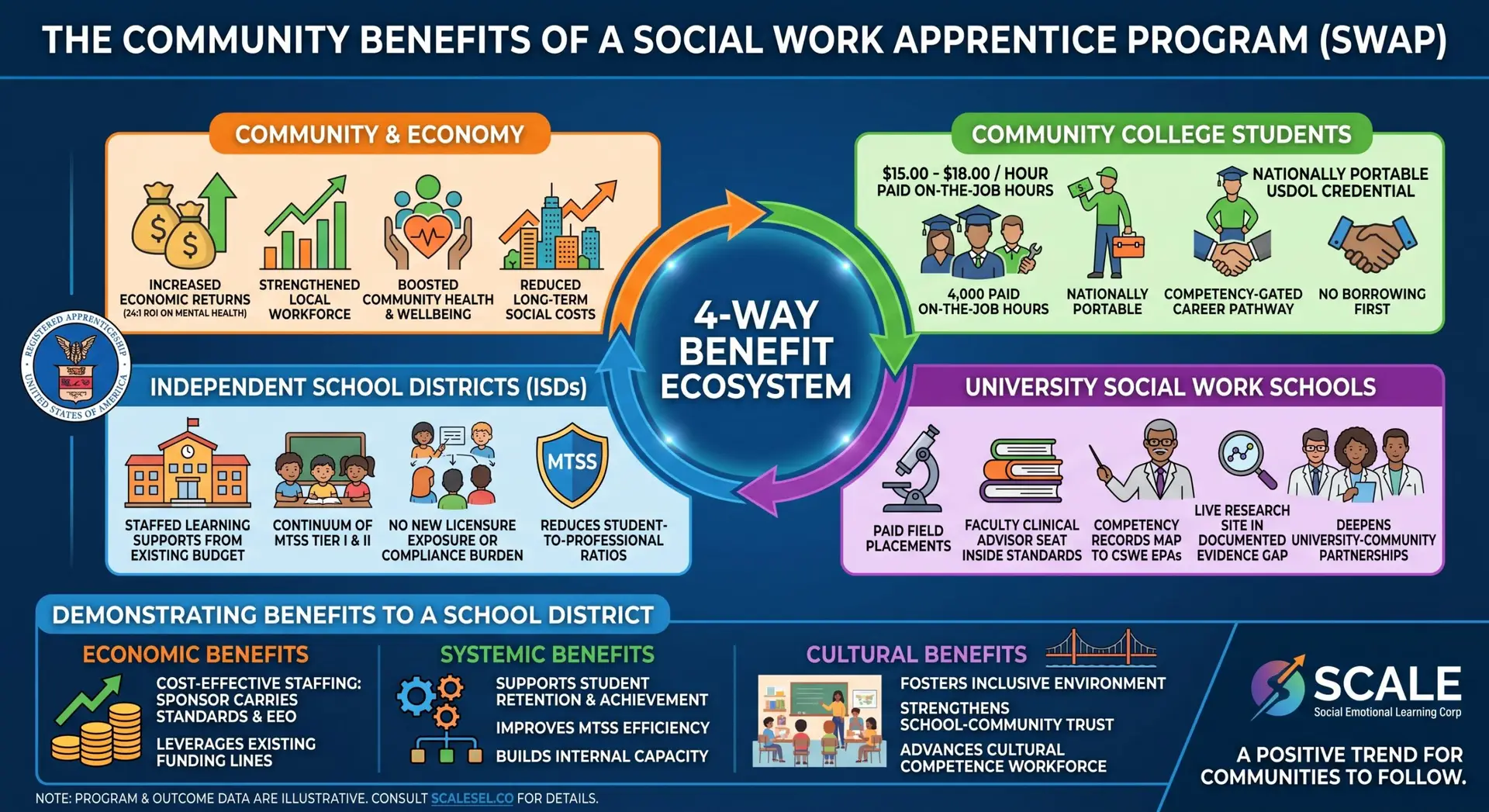
School Districts
Employer Partner: Staffed learning supports are paid from a line you already hold. No new appropriation, no new licensure exposure, and no compliance burden: the sponsor carries the standards, RAPIDS administration, records, and EEO obligations.
Community Colleges
Employer Partner: A paid, competency-gated pathway into Health and Human Service Careers — $15.00 to $18.00 an hour as competencies are demonstrated, 2,000 paid on-the-job hours, and a nationally portable credential earned without borrowing first.
State University
Affiliate Partner: School of Social Work and Public Policy – Paid field placements, a faculty clinical advisor, an external reviewer, and an evaluation partner aligning with CSWE 2022 EPAS without translation, while contributing to a documented evidence gap.
The Community
Corporate Social Responsibility: Our corporate partners embrace systemic change as essential to the transfer of wealth and the strengthening of social connections between schools and their communities, thereby enhancing educational productivity.
Jobs, Learning Supports & Workforce Development
Job's for Transition-Age Youth.
The U.S. Bureau of Labor Statistics reports that overall youth unemployment is 9.1%. However, the rate increases for youth in communities facing structural disadvantages— climbing to 12.0% for Black youth and 11.0% for Asian youth
Social Skills & Emotional Intelligence for Children and Youth
A comprehensive global investment analysis published by RTI International calculated that for every $1 invested in adolescent mental health interventions, the community captures $24 in economic benefits over time.
Cultural Competence Workforce Development.
To support children, youth, and families, SWAP advances cultural competence for A.A., B.S., and M.S.W. students, preparing our future health and human service workforce.
What We Claim
SWAP has no completed outcome evaluation. Our partners are invited to help design the evaluation. SWAP is a U.S. Department of Labor-registered apprenticeship (Registration No. 2026-TX-140696)
Complimentary Consultation
Email: scalesel@scalesel.co – Please let us know your state, county, and how you would like to partner, and we’ll take care of the rest.
Scale Social Emotional Learning Corporation.
Our Mission: Refine a pathway to income security and positive childhood experiences in underserved communities.
Social Work Apprentice Program · Registered Apprenticeship, U.S. Department of Labor · Registration No. 2026-TX-140696 · O*NET 21-1029.00
A program of Scale Social Emotional Learning Corporation. Copyright 2026